Custodia Gets Crypto Industry Backing in Supreme Court Fed Case
The Blockchain Association urged the US Supreme Court to hear Custodia Bank’s challenge over its denied Fed master account as crypto firms push deeper into US banking.
YayaNews contributes financial news and market context through the YayaNews editorial workflow.
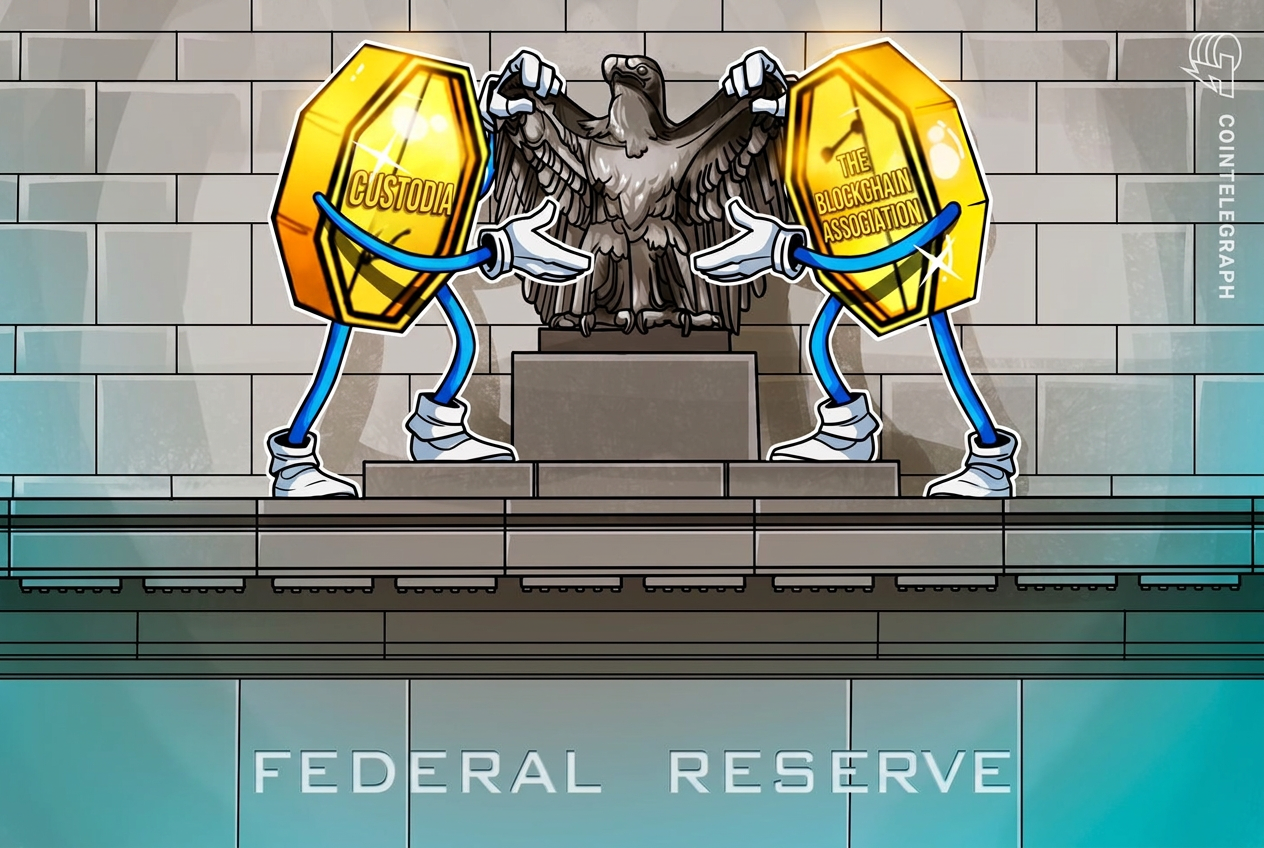
The Blockchain Association urged the US Supreme Court to hear Custodia Bank’s challenge over its denied Fed master account as crypto firms push deeper into US banking.
Custodia Gets Crypto Industry Backing in Supreme Court Fed Case
DOGE
$0.06988
1.30%
TRX
$0.3338
0.66%
LINK
$8.76
0.06%
ZEC
$485.54
2.25%
ADA
$0.1817
0.78%
XRP
$1.00
0.35%
ETH
$1,876.51
0.59%
BTC
$63,129.33
0.51%
XMR
$398.38
0.62%
BNB
$608.10
0.42%
XLM
$0.1594
0.03%
SOL
$75.75
0.20%
HYPE
$57.43
1.01%
Written by
Nate Kostar
staff writer
Reviewed by
Robert Lakin
staff editor
Written by
Nate Kostar
staff writer
Reviewed by
Robert Lakin
staff editor
Crypto group backs Custodia in Supreme Court battle over Fed access
Latest News
Published
Aug 13, 2026
The Blockchain Association argues the Fed should not have broad discretion to deny eligible state-chartered banks direct access to its payment system.
The Blockchain Association urged the US Supreme Court to hear Custodia Bank’s challenge to the Federal Reserve’s denial of its application for a master account, which would give the crypto-focused bank direct access to the Fed’s payment system.
In an amicus brief
filed
Wednesday, the industry group argued that federal law requires the central bank to make its payment services available to eligible nonmember banks and that the Fed should not have broad discretion to deny access.
The association said the appeals court’s decision effectively gives the Fed veto power over state-chartered banks by allowing it to withhold services needed to operate independently. It also linked Custodia’s case to alleged crypto debanking under “
Operation Choke Point 2.0
,” arguing that federal regulators discouraged banks from serving the digital asset industry.
Custodia, a Wyoming-chartered bank focused on digital assets, applied for a Fed master account in 2020, seeking direct access to the central bank’s payment services without relying on an intermediary bank.
The Federal Reserve Bank of Kansas City denied Custodia’s application in 2023, and the Tenth Circuit Court of Appeals later ruled that the regional Fed bank had discretion to reject its request. In March, the
appeals court voted
7-3 against rehearing the case, leaving the Supreme Court as Custodia’s only remaining avenue for review.
The Blockchain Association said the Tenth Circuit interpreted the Fed’s authority too broadly, potentially allowing it to deny payment-system access to eligible state-chartered banks serving the crypto industry.
Blockchain Association backs Custodia’s Supreme Court petition. Source:
US Supreme Court filing
Related:
Goldman Sachs CEO backs ‘not perfect’ CLARITY Act as vote expected soon
Crypto companies push deeper into US banking
Custodia’s challenge comes as other crypto companies are gaining greater access to the US banking system, including federal charters and, in one case, direct access to Federal Reserve payment rails.
In March, Kraken Financial became the first
crypto banking unit
to receive a limited-purpose master account from the Federal Reserve Bank of Kansas City, giving it direct access to Fedwire. The approval contrasts with Custodia’s rejection by the same regional Fed bank in 2023.
In April, Coinbase received
conditional approval from the Office of the Comptroller of the Currency (OCC)
to establish a national trust company, bringing its custody business under federal oversight without allowing it to take retail deposits or operate as a commercial bank.
Circle received final
OCC approval
for its national trust bank in July, while Kraken parent Payward applied for its own
national trust company charter
the following month. The OCC also conditionally approved national trust bank applications from Ripple, BitGo, Fidelity Digital Assets and Paxos in December.
The trend has drawn resistance from traditional banking groups. The Independent Community Bankers of America
opposed Coinbase’s approval
in April, arguing that crypto companies are seeking the benefits of bank charters without being subject to the full regulatory framework applied to traditional banks.
Magazine:
Bitcoin will never fall below $60K again: Nansen founder
Subscribe to daily byte-sized crypto news from Cointelegraph
Subscribe
Cointelegraph is committed to independent, transparent journalism. This news article is produced in accordance with Cointelegraph’s
Editorial Policy
and aims to provide accurate and timely information. Readers are encouraged to verify information independently.
Banks
United States
Coinbase
Kraken
Paxos
Regulation
More on the subject
Copper US arm becomes FINRA member, SEC-registered broker-dealer
10 hours ago
Yohan Yun
Arizona crypto ATM law helps 35 scam victims recover $171K
18 hours ago
Ezra Reguerra
Hawaii crypto ATM ban to take effect on Oct. 1
20 hours ago
Turner Wright
Copper US arm becomes FINRA member, SEC-registered broker-dealer
10 hours ago
Yohan Yun
Arizona crypto ATM law helps 35 scam victims recover $171K
18 hours ago
Ezra Reguerra
Hawaii crypto ATM ban to take effect on Oct. 1
20 hours ago
Turner Wright
Original YayaNews editorial coverage, published for informational purposes.
This article is sourced from CoinTelegraph. It is for informational purposes only and does not constitute investment advice.
Topics & Symbols
Continue Reading
Related Reading
Upbit Lists PROM with KRW and USDT Trading Pairs, Opening New Opportunities for Mid-Cap Tokens
Upbit announced the addition of PROM KRW and USDT trading pairs, with a market cap of approximately $43.5 million. This article analyzes the significance, project background, and market impact for investors.

SEC Prepares Major Crypto Plan as Clarity Act Stalls: What It Means for Markets
As the Clarity Act remains gridlocked, the SEC is reportedly preparing a significant crypto regulatory plan. This article analyzes potential new rules covering DeFi, stablecoins, and exchanges, market reactions, and the global competitive pressures shaping U.S. oversight.

Binance Launches DOSUSDT Perpetual Contract: Market Impact and Investment Strategy Analysis
Binance announced the listing of the USDⓈ-M DOSUSDT perpetual contract on August 11, 2026. This article analyzes the announcement background, market reactions, and investment risks to help investors seize opportunities.
Ireland Plans Industry Standards for Illicit Crypto Use
The strategy prepared by the Irish government’s finance department included industry standards on crypto used for gambling and strengthening AML/CFT measures in certain cases.