SEC's big swing to clear tokenization path isn't likely to get resilience of full rule
Former SEC lawyers say that using its power to grant tokenization "innovation" efforts an exemption from securities law isn't as strong as a full-fledged rule.
YayaNews contributes financial news and market context through the YayaNews editorial workflow.
Former SEC lawyers say that using its power to grant tokenization "innovation" efforts an exemption from securities law isn't as strong as a full-fledged rule.
SEC's big swing to clear tokenization path isn't likely to get resilience of full rule
News Analysis
SEC's big swing to clear tokenization path isn't likely to get resilience of full rule
Former SEC lawyers say that using its power to grant tokenization "innovation" efforts an exemption from securities law isn't as strong as a full-fledged rule.
By
Jesse Hamilton
|
Edited by
Nikhilesh De
Jun 14, 2026, 2:00 p.m.
5
min read
Make
preferred on
Share
Share this article
Copy link
X icon
X (Twitter)
Make
preferred on
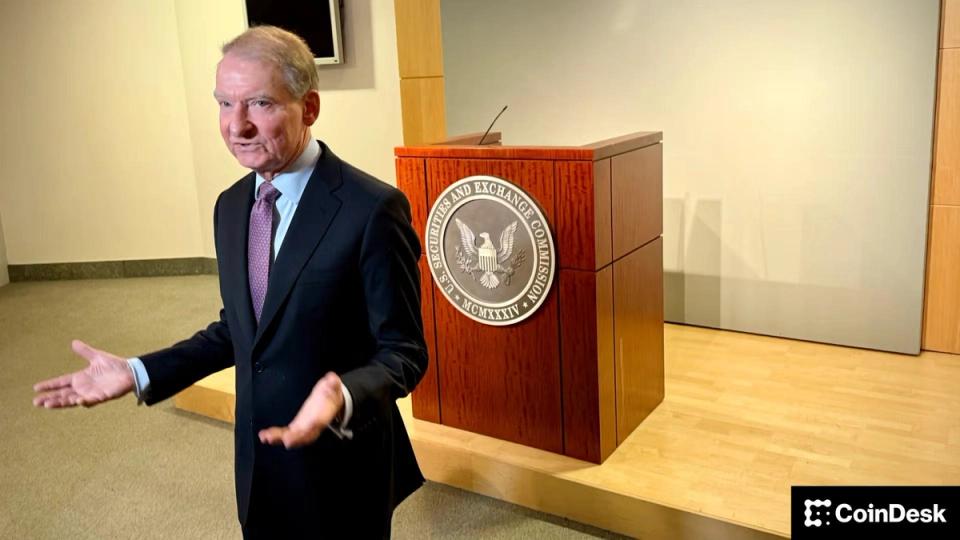
Chairman Paul Atkins' U.S. Securities and Exchange Commission is likely to use a mid-level authority to pursue a tokenization policy. (Jesse Hamilton/CoinDesk)
Summary
Show
The U.S. Securities and Exchange Commission's forthcoming "innovation exemption" for tokenization isn't expected to rate at the top of the agency's hierarchy of policy durability, despite the crypto sector's years-long wait to get U.S. rules set in stone.
Former SEC lawyers say the agency's power to exempt activity from securities laws would still be difficult to reverse, though agency leaders have said this initial policy will be narrow and time-limited.
The U.S. Securities and Exchange Commission is preparing one of the most consequential of Chairman Paul Atkins' crypto policies, a new approach that grants some regulatory leeway to those seeking to tokenize securities,
such as company stocks
. But it's not yet what the crypto sector has asked for: permanent policy it can rely on, which still may be a long way off.
The SEC has an option to pursue formal tokenization rulemaking — the closest it can get to carving something in stone, with a process that involves multiple rounds of public comment and revisions that incorporate that feedback. But the agency instead signaled it's working on exercising its standing authority to exempt businesses from securities laws, planning to temporarily grant abilities to put assets onto blockchains as a proving ground to test potential financial innovations.
"It doesn't have to be done as a rulemaking," said SEC Commissioner Hester Peirce, who has led much of the agency's crypto work since the start of last year. In response to a question from CoinDesk, she said the SEC has exemptive authority that it routinely uses. "We can do it as a rule, but we don't have to do it as a rule."
In March, SEC Chairman Paul Atkins described the incoming policy as "an innovation exemption to facilitate limited trading of certain tokenized securities with an eye toward developing a long-term regulatory framework." He said it would be "limited in time and scope, but long enough so that we can craft more durable rules that harness the full potential of these new technologies."
More recently
in May, he added
: "I also think we should consider what a future-proofed framework may look like, which would take the form of notice-and-comment rulemaking and would address the 'exchange' definition as applied to onchain trading systems."
CoinDesk canvassed the views of several lawyers who are former officials at the SEC, asking questions about the choice to put off formal rulemaking, and whether the interim work on this will hold up. Most agreed that the approach may not carry the highest force of SEC authority, but it'd still be difficult to put the toothpaste back into the tube if the next administration sees things differently.
"The end goal is ultimately a statute or rule that provides certainty," said Charles Riely, a former assistant regional director in SEC enforcement who is now a partner at Jenner & Block. "The question is whether the innovation exemption can be a step toward that."
"Given the increasing participation in digital asset markets, it will be very hard for a future administration to undo this work and bring cases where investor harm is absent," he said.
Tenuous ground
Despite the current no-show of a new crypto Digital Asset Market Clarity Act from Congress, the SEC has been busy in this pursuit of its own brand of crypto clarity on the tokenization stance and other crypto policy directives. However, the actions across various topics — memecoins, mining, the definition of physical possession, the
treatment of software interfaces for investor wallets
and others — have often rested on interim, staff-level positions and statements, without even the authority of the commission itself. These could be easy to sweep away in the event new leadership arrives at the SEC in a few years with a different view.
Exemptions, such as what seems to be contemplated with the upcoming tokenization policy, are commission-decided actions that have more heft than staff statements.
"Under the federal securities laws, there's very broad exemptive authority, almost for all the acts the commission has the ability to engage in," said
Thoreau Bartmann
, a lawyer at K&L Gates who served as co-chief counsel of the SEC's Division of Investment Management, in an interview with CoinDesk. He said one reason the agency may be punting is a lack of explicit rulemaking authority for crypto topics in existing law.
"The exemptive route might actually make more sense for the commission, because it's basically saying you — crypto — don't have to follow these rules," Bartmann said, "until we get some sort of durable grant of rulemaking authority."
The future rules that could emerge from authorities granted in a new law would be even more difficult and time-consuming to institute, and also to dig out once they're set.
Rules take time
A proper rulemaking "requires at least 12 to 18 months," said Patrick Daughtery, a former SEC lawyer who represents crypto interests at Foley & Lardner and recently
joined the SEC's investor advisory committee
. Finished rules can also be pulled back, but that takes its own long process of issuing notices and gathering public comments, "as can be seen in the current SEC proposal to rescind the agency’s Biden-era climate-change rules."
The agency may be weighing the difficulty the industry might have experienced while waiting for rulemaking and that granting temporary exemptions would be sturdy enough that they're not practical to overturn. Daugherty argued that a future commission would be hard-pressed to reverse policies "that would destroy the economic value created by the new products and services, once introduced and seasoned for a while."
Tokenization — the concept of turning traditional assets into tokens that can be transacted on blockchains — is where much of the crypto-world momentum is currently centered, and its advocates say it'll revolutionize trading by offering 24/7 activity, elimination of some intermediaries and instant completion of transactions.
As agency staff crafts its innovation exemption, which has been said to be poised for release for several months, the SEC has to work out its
stance on tokens generated by third parties
(without ties to the issuance of the underlying securities), how purchasers may be identified in secondary sales and generally how the tokens that are representing securities will carry shareholder voting abilities, dividend rights and security measures.
The aim of blockchain advocates is that this SEC policy push will give traditional financial firms and institutional investors the confidence to
engage in earnest
with the new products, opening the financial floodgates. For some, a pure agency action without backing from a new law, such as the Clarity Act, may not be enough.
"It depends on the risk tolerance of the entity involved," said
Ashley Ebersole
, chief legal officer of Sologenic and a former senior counsel at the SEC. "Legislation is the only way of obtaining the permanence demanded by some players to enter the crypto space or offer certain products in the U.S."
Despite Chairman Atkins' aggressive press into crypto policies that he said his agency has ample authority to write, he's acknowledged that the SEC really does need U.S. lawmakers to wield their stamp of permanence.
"We really need to have Congress speak to this area," Atkins said
at an industry event in April.
He said his agency's legal backbone is still set in 1930s-based law, so it's vital "to have a statute that would future-proof what's going forward."
Read More:
Citi opens new route into private markets with tokenized share offering
Regulation
Tokenization
Latest Crypto News
1
Ether, XRP and dogecoin lead a broad crypto selloff as tech stocks tumble
33 minutes ago
2
Live markets: Bitcoin rebounds to nearly $60,000. Kospi, Nikkei sink
1 hour ago
3
Asset management giant Invesco files for tokenized fund targeting stablecoin reserve market
9 hours ago
4
Coinbase's Base blockchain resumes after two-hour outage disrupted network
11 hours ago
5
Strategy's yield-generating STRC stock is more correlated with BTC than ever
12 hours ago
6
Kraken in talks to buy 15% stake in DeFi lender Aave at $385 million valuation
13 hours ago
7
a16z-backed crypto firm rebrands, shifts focus to solving AI’s global copyright headache
13 hours ago
8
BlackBerry is making a massive comeback as an 'uncrashable' software layer for AI and robotics
14 hours ago
9
Strategy has a 10-month cash runway for dividends, but retail investors are losing faith
14 hours ago
10
Quant fund says bitcoin is near a major inflection point as rare onchain signals align
15 hours ago
Latest Research
CEX Volumes Drop to Lowest Since September 2024 as RWA Perps Hit Record High
CEX Volumes Drop to Lowest Since September 2024 as RWA Perps Hit Record High
In May, combined exchange volumes fell 3.45% to $4.41T; the lowest since September 2024. RWA perpetual futures volumes rose 10.4% against the trend, hitting a new all-time high.
By
CoinDesk Research
Jun 15, 2026
In May, combined exchange volumes fell 3.45% to $4.41T; the lowest since September 2024. RWA perpetual futures volumes rose 10.4% against the trend, hitting a new all-time high.
Why it matters
:
In May, combined exchange volumes fell 3.45% to $4.41T; the lowest since September 2024. RWA perpetual futures volumes rose 10.4% against the trend, hitting a new all-time high.
View Full Report
More From
News Analysis
In Clarity Act's final weeks, its path through U.S. Senate not getting much clearer
Clarity Act survival depends on the U.S. Senate getting a lot of non-crypto work done
The crypto industry’s massive political war chest is starting to lean Republican ahead of midterms
CD20
$1,599.68
CD20 down 3.82 percent
3.82%
BTC
$59,653.50
BTC down 3.23 percent
3.23%
ETH
$1,543.51
ETH down 6.53 percent
6.53%
XRP
$1.03
XRP down 5.36 percent
5.36%
SOL
$68.01
SOL down 1.95 percent
1.95%
Original YayaNews editorial coverage, published for informational purposes.
This article is sourced from CoinDesk. It is for informational purposes only and does not constitute investment advice.
Topics & Symbols
Continue Reading
Related Reading
Upbit Lists PROM with KRW and USDT Trading Pairs, Opening New Opportunities for Mid-Cap Tokens
Upbit announced the addition of PROM KRW and USDT trading pairs, with a market cap of approximately $43.5 million. This article analyzes the significance, project background, and market impact for investors.

SEC Prepares Major Crypto Plan as Clarity Act Stalls: What It Means for Markets
As the Clarity Act remains gridlocked, the SEC is reportedly preparing a significant crypto regulatory plan. This article analyzes potential new rules covering DeFi, stablecoins, and exchanges, market reactions, and the global competitive pressures shaping U.S. oversight.

Binance Launches DOSUSDT Perpetual Contract: Market Impact and Investment Strategy Analysis
Binance announced the listing of the USDⓈ-M DOSUSDT perpetual contract on August 11, 2026. This article analyzes the announcement background, market reactions, and investment risks to help investors seize opportunities.
Ireland Plans Industry Standards for Illicit Crypto Use
The strategy prepared by the Irish government’s finance department included industry standards on crypto used for gambling and strengthening AML/CFT measures in certain cases.