
Tether's USDT hits 2-year countdown threatening its position on U.S. crypto platforms
The GENIUS Act has hit its first anniversary without U.S. regulators yet meeting deadlines to write regulations, though rules will be in full effect by July 2028.
YayaNews contributes financial news and market context through the YayaNews editorial workflow.
Tether's USDT hits 2-year countdown threatening its position on U.S. crypto platforms
News Analysis
Tether's USDT hits 2-year countdown threatening its position on U.S. crypto platforms
The GENIUS Act has hit its first anniversary without U.S. regulators yet meeting deadlines to write regulations, though rules will be in full effect by July 2028.
By
Jesse Hamilton
|
Edited by
Nikhilesh De
Jul 19, 2026, 1:00 p.m.
6
min read
Make
preferred on
Share
Share this article
Copy link
X icon
X (Twitter)
Make
preferred on
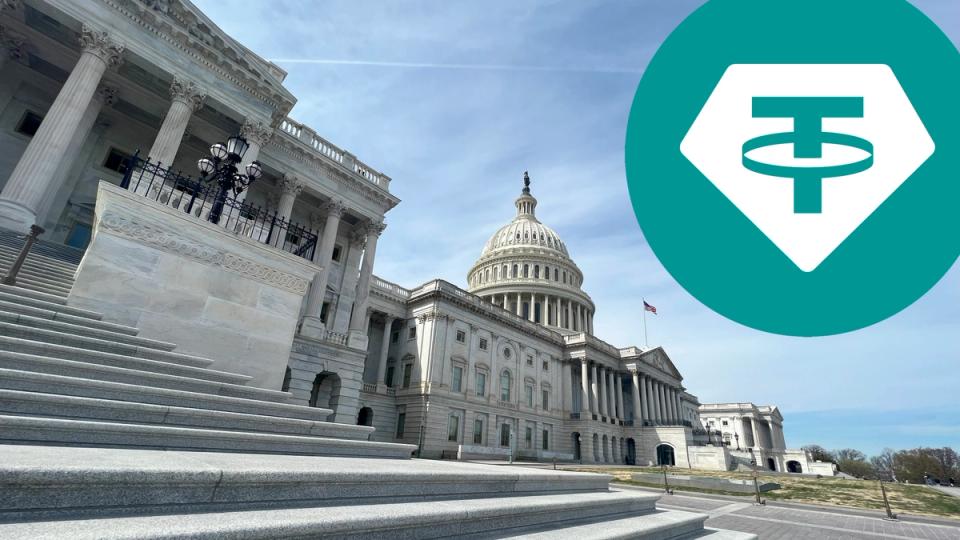
The U.S. GENIUS Act to regulate stablecoins just hit a milestone, and Tether may have some compliance work ahead of it. (Jesse Hamilton/CoinDesk)
Summary
Show
The GENIUS Act that governs U.S. stablecoin issuers is complicated and a work-in-progress, but now that its first anniversary is reached, Tether and other non-U.S. issuers have two years left to figure out their compliance strategies.
The one-year mark was supposed to see the federal financial regulators finishing their stablecoin rules, but none have done so, yet, leaving some compliance uncertainty.
The basic outlines of the U.S. standards, though, would force the most widely circulated coin — Tether’s USDT — to make a lot of major changes before it could satisfy the law.
The world's leading stablecoin by volume, Tether's USDT, could be shoved out of the U.S. markets if the company doesn't revamp dramatically in the next two years.
Despite
assurances last year from CEO Paolo Ardoino
that the stablecoin giant would achieve U.S. compliance for USDT, the company hasn't yet revealed a sharp turn toward the demands of the Guiding and Establishing National Innovation for U.S. Stablecoins (
GENIUS
) Act, which became law one year ago.
With that consequential anniversary of
President Donald Trump's signing
of the law passing on Saturday, the industry has marked a surge in stablecoin interest and issuance, plus a wide array of crypto and traditional financial firms pursuing U.S. trust bank charters to ease their stablecoin pathways. But the one-year mark was also supposed to be a deadline for federal financial regulators to have rules in place implementing GENIUS, and they've so far fallen short. That could be problematic as experts and industry insiders still reveal some disagreements over how the law should be interpreted.
At this point, it's still two firms battling for market dominance, with a few others — including the issuer tied to President Donald Trump, World Liberty Financial — fighting it out for a very distant third place. Tether's chief rival, U.S.-based Circle, has made more of an apparent effort to pre-comply with what U.S. regulations will soon require.
Meanwhile, Tether's
most recent disclosures
suggest as much as a quarter of USDT's reserves — the stockpile meant to ensure that those redeeming their coins will always be able to — were still plugged into assets that won't meet GENIUS Act standards, such as precious metals, lending and bitcoin
BTC
$
64,484.39
holdings. GENIUS requires that issuers are fully reserved in the most highly liquid and reliable assets — essentially cash and U.S. Treasuries.
"Tether will comply with the GENIUS Act," Ardoino
told CoinDesk at the White House
, in the moments after Trump signed GENIUS a year ago. While the CEO indicated then that his company would pursue a separate U.S.-specific token, he said that USDT would also be managed to meet the law's foreign-issuer standards.
When asked multiple times for an update on its compliance stance in recent days, representatives of El Salvador-based Tether didn't offer a response.
This year, Tether
rolled out USAT
— launched with U.S. standards in mind and issued through U.S. banking partner Anchorage Digital. So far, it remains at a relatively low level of usage.
“Non-compliant stablecoins cannot be used by U.S. institutions when the safe harbor expires in 2028, but we don’t expect the market to wait," said Kevin Wysocki, head of policy at Anchorage Digital, the crypto-native bank that manages a number of stablecoins. He said the company believes institutional users will move toward "compliant, bank-issued digital dollars well ahead of that deadline."
Do they have two years?
GENIUS included a three-year grace period for compliance, and two years remain, after which U.S. crypto platforms won't be able to offer stablecoins whose issuers haven't checked all the regulatory boxes. However, there seems to be some disagreement over whether foreign issuers are meant to enjoy that same safe harbor. Some lawyers in finance assume that Tether gets until July 18, 2028, to comply, but others have suggested that foreign issuers would have to comply the moment GENIUS officially goes live, which is likely six months from now in January.
"Upon the effectiveness of the GENIUS Act, foreign issuers will need to immediately comply with lawful orders to seize and freeze coins held by illicit actors, but they will have a runway of approximately two more years to prepare for the additional requirements so that their coins may remain eligible for listing on U.S. centralized trading platforms," said
Justin Levine
, a lawyer at Davis Polk who advises clients on stablecoin issues, adding that one of those remaining requirements — registration with the Office of the Comptroller of the Currency — is likely to require a “significant undertaking”
"So they do have time, as long as they comply with seize and freeze orders,” he said. “But those that want to have their coins continue to be traded on U.S. centralized platforms and have that liquidity should still be thinking about it right now, even if it's not imminent that they're going to get delisted."
While Levine's firm and others have interpreted the deadline for foreign issuers as being two years away, an analysis last year from law firm Paul Hastings had read GENIUS as offering separate timelines for foreign and domestic firms. But after being asked about its view recently, that interpretation was removed from the firm's website, and its spokespeople didn't immediately respond to CoinDesk's requests for clarity.
A dive into the footnotes of federal regulators suggests a two-track deadline in the law. The OCC, the national bank regulator that will also be supervising certain stablecoin issuers,
said in a footnote
within a proposal for implementing aspects of GENIUS that the drop-dead date was generally in 2028, but that it gets triggered the moment the law is effective (by January) for the coins of foreign issuers that don't meet "certain requirements." Those requirements, though, could simply be referring to the shorter-term demands that include the ability to freeze bad actors' assets and, when requested by the government, to seize them.
The fuller slate of requirements for foreign issuers will eventually include demands that their home regulator be certified by the secretary of the Treasury as being "comparable" to the U.S. regime, that the firms be OCC-registered and they keep their reserves in U.S. institutions.
Regulators run behind
However, none of the federal agencies have finalized their GENIUS rules, leaving some uncertainty about what will be set into regulatory stone even as the first requirements approach. A number of regulators' efforts are underway and may soon be completed, but others remain in preliminary stages. In other words, companies have no regulations to comply with just yet.
If there's lingering disagreement over GENIUS timelines,
Trevor Tanifum
, a managing principal at consulting firm FS Vector, said he anticipates that smaller platforms with low risk appetites will delist certain stablecoins and avoid the bother. But others may be willing to press on.
He said that prominent companies with robust legal departments may be willing to occupy a different view, such as: "We're going to spend the money on lawyers and lobbyists until someone walks up to our door and forces us to delist these non-U.S. issuers."
"It's pretty much what has happened, I think, at every major crypto hurdle," he said. "These platforms still count on a lot of transaction volumes, liquidity from non-U.S. issuers, and so I can't see them giving up those volumes without a fight."
The biggest U.S. exchange is Coinbase, but the company declined to discuss its stablecoin listing plans under GENIUS.
The exchange and much of the rest of the crypto industry has more recently shifted policy attention toward a different effort of Congress: the Digital Asset Market Clarity Act. The sector's lobbyists had aimed for a one-two punch with GENIUS and Clarity, and they'd succeeded last year in getting the stablecoin bill passed into law.
But that first major crypto law was meant to complement a wider-reaching regulation of U.S. crypto markets under the Clarity Act, which is still languishing in the final weeks of its potential 2026 congressional window. It remains unclear at the first anniversary of the GENIUS Act whether its companion will join it on the books. And if it does, it's likely to include some provisions that overhaul some of GENIUS's language.
Either way, Tether, Circle and the rest of the stablecoin sector are on track to be federally regulated in the coming months under the new law, and how those regulations are navigated may upend which firms play a leading role.
Tether
Stablecoins
Regulation
Related Assets
Bitcoin
$
64,492.50
0.63
%
Latest Crypto News
1
AI is destroying the internet. Math is our only hope.
14 minutes ago
2
Kraken says simpler options can unlock crypto's next derivatives market
1 hour ago
3
Bitcoin’s quantum problem gets a recovery tool, but not for Satoshi’s 1.1 million coins
4 hours ago
4
Inside Zcash's new node that targets Visa-scale privacy at 50,000 transactions per second
8 hours ago
5
France orders country's internet service providers to block Polymarket
16 hours ago
6
Crypto executives say digital native generations may never need a bank account
19 hours ago
7
DOG Mode explains Bitcoin's next governance fight
21 hours ago
8
Trump targets Brazil's payments system while dollar stablecoins are quietly overtaking country's payments
22 hours ago
9
Here is why a massive $1.6 billion in crypto liquidity is sitting idle and wasting away
22 hours ago
10
Massive bitcoin call spreads target $72,000 by month end, right when the Fed meets
23 hours ago
Latest Research
Gate Leads Spot Market Share Gains as CEX Volumes Rise for First Time in Five Months
Gate Leads Spot Market Share Gains as CEX Volumes Rise for First Time in Five Months
CEX trading volumes rose for the first time in five months in June, with spot climbing 15.3% to $1.11T and RWA perpetual volumes surging to a record $311B.
By
CoinDesk Research
Jul 13, 2026
CEX trading volumes rose for the first time in five months in June, with spot climbing 15.3% to $1.11T and RWA perpetual volumes surging to a record $311B.
Why it matters
:
CEX trading volumes rose for the first time in five months in June, with spot climbing 15.3% to $1.11T and RWA perpetual volumes surging to a record $311B.
View Full Report
More From
News Analysis
Kalshi and prediction market sector embroiled in mixed bag of legal fights across U.S.
In Clarity Act's final weeks, its path through U.S. Senate not getting much clearer
SEC's big swing to clear tokenization path isn't likely to get resilience of full rule
More From
Bitcoin
AI is destroying the internet. Math is our only hope.
Kraken says simpler options can unlock crypto's next derivatives market
Bitcoin’s quantum problem gets a recovery tool, but not for Satoshi’s 1.1 million coins
Crypto
CD20
$1,750.63
CD20 up 0.74 percent
0.74%
BTC
$64,491.03
BTC up 0.62 percent
0.62%
ETH
$1,872.76
ETH up 1.51 percent
1.51%
XRP
$1.09
XRP up 0.54 percent
0.54%
SOL
$76.22
SOL up 1.73 percent
1.73%
Original YayaNews editorial coverage, published for informational purposes.
This article is sourced from CoinDesk. It is for informational purposes only and does not constitute investment advice.
Topics & Symbols
Continue Reading
Related Reading
Upbit Lists PROM with KRW and USDT Trading Pairs, Opening New Opportunities for Mid-Cap Tokens
Upbit announced the addition of PROM KRW and USDT trading pairs, with a market cap of approximately $43.5 million. This article analyzes the significance, project background, and market impact for investors.

SEC Prepares Major Crypto Plan as Clarity Act Stalls: What It Means for Markets
As the Clarity Act remains gridlocked, the SEC is reportedly preparing a significant crypto regulatory plan. This article analyzes potential new rules covering DeFi, stablecoins, and exchanges, market reactions, and the global competitive pressures shaping U.S. oversight.

Binance Launches DOSUSDT Perpetual Contract: Market Impact and Investment Strategy Analysis
Binance announced the listing of the USDⓈ-M DOSUSDT perpetual contract on August 11, 2026. This article analyzes the announcement background, market reactions, and investment risks to help investors seize opportunities.
Ireland Plans Industry Standards for Illicit Crypto Use
The strategy prepared by the Irish government’s finance department included industry standards on crypto used for gambling and strengthening AML/CFT measures in certain cases.
