DeFi users are missing out on $150 million a year. Here’s why
About $542 million weekly sat outside active trading ranges, meaning this capital earned zero fees and provided no market depth.
YayaNews contributes financial news and market context through the YayaNews editorial workflow.
DeFi users are missing out on $150 million a year. Here’s why
Web3
Here is why a massive $1.6 billion in crypto liquidity is sitting idle and wasting away
About $542 million weekly sat outside active trading ranges, meaning this capital earned zero fees and provided no market depth.
By
Francisco Rodrigues
|
Edited by
Aoyon Ashraf
Updated
Jul 18, 2026, 3:53 p.m.
Published
Jul 18, 2026, 3:50 p.m.
3
min read
Make
preferred on
Share
Share this article
Copy link
X icon
X (Twitter)
Make
preferred on
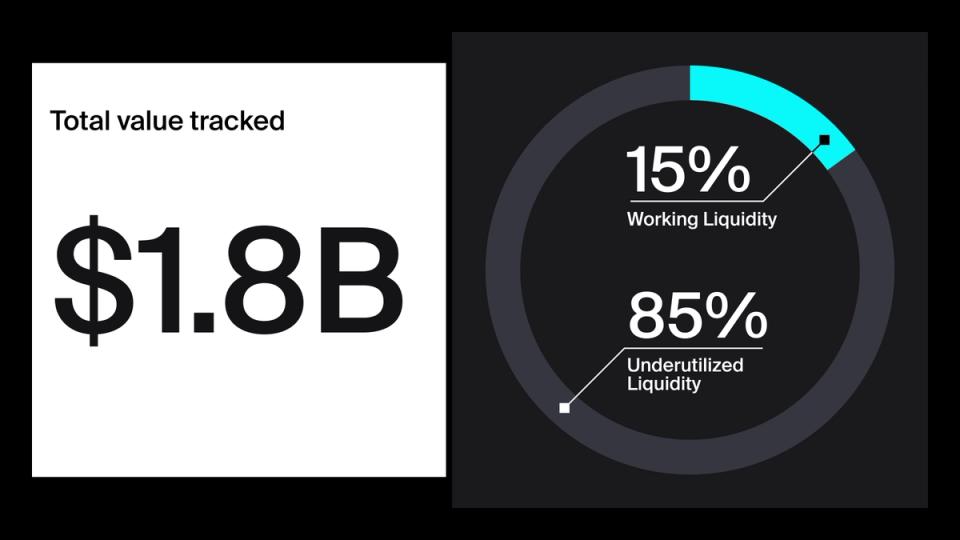
Most of DeFi's "tracked" liquidity remains under utilised. (Dune/1inch)
Summary
Show
Dune research found that $1.6 billion in DeFi liquidity was underutilized in H1 2026, failing to generate returns.
About $542 million weekly sat outside active trading ranges, meaning this capital earned zero fees and provided no market depth.
While out-of-range positions miss around $150 million in annual fees, maintaining active positions involves transaction costs and execution risks.
About $1.6 billion in liquidity deposited across major decentralized exchanges was not being used to its full potential during the first half of 2026, a new research finds.
The figure represents 85% of the $1.84 billion tracked across concentrated liquidity pools on Uniswap, PancakeSwap and Aerodrome, according to research by analytics firm Dune commissioned by decentralized exchange aggregator 1inch.
Roughly $542 million, or 29.5%, sat fully out of range in an average week. The money had not left the decentralized finance ecosystem. It was priced so high that traders could not use it.
The findings come as retail platforms
bring more users
and traditional assets onchain and financial firms expand their
work on tokenized funds
and blockchain-based settlement. 1inch argues that idle liquidity will become more costly as markets grow, more capital will be stranded, and more trading fees will go unearned as liquidity becomes thinner.
“Decentralized exchanges have grown into one of the deepest, most liquid markets in crypto,” said Filippo Armani, research lead at Dune. “What our research shows is that it has reached this scale even though much of its liquidity is not yet fully at work.”
Concentrated liquidity pools let providers place assets within a chosen price range. The capital supports more trading and collects more fees while the market stays within that range; once the price moves beyond it, the position stops working until the provider adjusts the range or the market returns to its original setting.
For example, a position in an ETH/USDC pool set between $2,000 and $2,500 stops earning fees if the price of ETH moves outside that band. The provider must set a new range or wait for the market to return to it.
Dune tracked Uniswap v3 and v4, PancakeSwap v3 and Aerodrome Slipstream across 7 chains using weekly snapshots from Jan. 6 to June 30. The out-of-range share stayed mostly between 25% and 35%, rising to nearly 41% in early February.
The study linked idle liquidity more closely to price movements than to volatility. A steady price move in one direction is more likely to strand capital than a volatile week that ended near where it began. Incidentally, the bitcoin price was hovering near $90,000 during January before crashing to around $60,000.
Additionally, larger positions are usually less likely to sit idle, but the research found that those pools of money still held most of the inactive capital.
Around 54% of liquidity in positions below $1,000 was out of range, compared with 26% for positions above $1 million. Yet positions worth more than $1 million accounted for 47% of all idle capital, or roughly $260 million.
While contract-managed positions stayed within a more consistent range, individual wallets accounted for between 82% and 94% of the attributed idle capital on Uniswap v3, depending on the chain. That suggests liquidity deposited directly by users and requiring manual adjustments is more likely to go unattended and fall out of range.
Dune estimated that these out-of-range providers, that are sitting idle, could be missing roughly $150 million in fees each year, based on a blended in-range fee APR of about 35%.
Liquidity providers deposit token pairs that decentralized exchanges use to complete swaps. They earn a share of the fees paid for trades using that liquidity pool while their positions remain in the range they set.
However, the research said that the figure is not guaranteed recoverable income. Keeping positions active can add transaction costs, execution risk and exposure to unfavorable price movements.
1inch commissioned the research ahead of the planned launch of
Aqua
, a new liquidity protocol. Dune said it developed the methodology and reached its conclusions independently.
Web3
DeFi
Latest Crypto News
1
Crypto executives say digital native generations may never need a bank account
43 minutes ago
2
DOG Mode explains Bitcoin's next governance fight
2 hours ago
3
Trump targets Brazil's payments system while dollar stablecoins are quietly overtaking country's payments
3 hours ago
4
Massive bitcoin call spreads target $72,000 by month end, right when the Fed meets
4 hours ago
5
Tokenization has become a strategic priority for 84% of financial firms
5 hours ago
6
Polymarket traders cut Clarity Act passage odds to record low as Senate delay drags on
Jul 17, 2026
7
Stripe and Swift race to control the next generation of global payments infrastructure
Jul 17, 2026
8
Cardano hands core development to outside teams in decentralization push
Jul 17, 2026
9
Inside Robinhood’s high-stakes bet to onboard millions of casual users onto decentralized finance
Jul 17, 2026
10
Japan's SBI Group is building Asia's first cross-border digital asset empire
Jul 17, 2026
Latest Research
Gate Leads Spot Market Share Gains as CEX Volumes Rise for First Time in Five Months
Gate Leads Spot Market Share Gains as CEX Volumes Rise for First Time in Five Months
CEX trading volumes rose for the first time in five months in June, with spot climbing 15.3% to $1.11T and RWA perpetual volumes surging to a record $311B.
By
CoinDesk Research
Jul 13, 2026
CEX trading volumes rose for the first time in five months in June, with spot climbing 15.3% to $1.11T and RWA perpetual volumes surging to a record $311B.
Why it matters
:
CEX trading volumes rose for the first time in five months in June, with spot climbing 15.3% to $1.11T and RWA perpetual volumes surging to a record $311B.
View Full Report
More From
Web3
Airbnb CEO says X account was hacked, attacker posted AI-slop on tokenization
Lending protocol Bonzo loses 77% of value locked as $9 million oracle exploit rattles Hedera
BNB Chain is building a new layer-1 for high-frequency trading and AI agents
Crypto
CD20
$1,746.52
CD20 up 0.57 percent
0.57%
BTC
$64,487.36
BTC up 0.56 percent
0.56%
ETH
$1,856.66
ETH up 0.74 percent
0.74%
XRP
$1.09
XRP down 0.034 percent
0.034%
SOL
$75.19
SOL up 0.042 percent
0.042%
Original YayaNews editorial coverage, published for informational purposes.
This article is sourced from CoinDesk. It is for informational purposes only and does not constitute investment advice.
Topics & Symbols
Continue Reading
Related Reading
Upbit Lists PROM with KRW and USDT Trading Pairs, Opening New Opportunities for Mid-Cap Tokens
Upbit announced the addition of PROM KRW and USDT trading pairs, with a market cap of approximately $43.5 million. This article analyzes the significance, project background, and market impact for investors.

SEC Prepares Major Crypto Plan as Clarity Act Stalls: What It Means for Markets
As the Clarity Act remains gridlocked, the SEC is reportedly preparing a significant crypto regulatory plan. This article analyzes potential new rules covering DeFi, stablecoins, and exchanges, market reactions, and the global competitive pressures shaping U.S. oversight.

Binance Launches DOSUSDT Perpetual Contract: Market Impact and Investment Strategy Analysis
Binance announced the listing of the USDⓈ-M DOSUSDT perpetual contract on August 11, 2026. This article analyzes the announcement background, market reactions, and investment risks to help investors seize opportunities.
Ireland Plans Industry Standards for Illicit Crypto Use
The strategy prepared by the Irish government’s finance department included industry standards on crypto used for gambling and strengthening AML/CFT measures in certain cases.