MoneyGram's CEO says blockchain works best when customers don't know it's there
In an interview with CoinDesk, MoneyGram CEO Anthony Soohoo said that their blockchain strategy has evolved from early experimentation into a broader effort to modernize the company's global payments infrastructure.
YayaNews contributes financial news and market context through the YayaNews editorial workflow.
In an interview with CoinDesk, MoneyGram CEO Anthony Soohoo said that their blockchain strategy has evolved from early experimentation into a broader effort to modernize the company's global payments infrastructure.
MoneyGram's CEO says blockchain works best when customers don't know it's there
Tech
MoneyGram's CEO says blockchain works best when customers don't know it's there
In an interview with CoinDesk, MoneyGram CEO Anthony Soohoo said that their blockchain strategy has evolved from early experimentation into a broader effort to modernize the company's global payments infrastructure.
著者
Margaux Nijkerk
|
編集者
Cheyenne Ligon
更新
2026年7月21日 午後2:21
公開日
2026年7月21日 午後1:38
AIによる翻訳
3
min read
Make
preferred on
共有
この記事を共有
リンクをコピー
X icon
X (Twitter)
メール
Make
preferred on
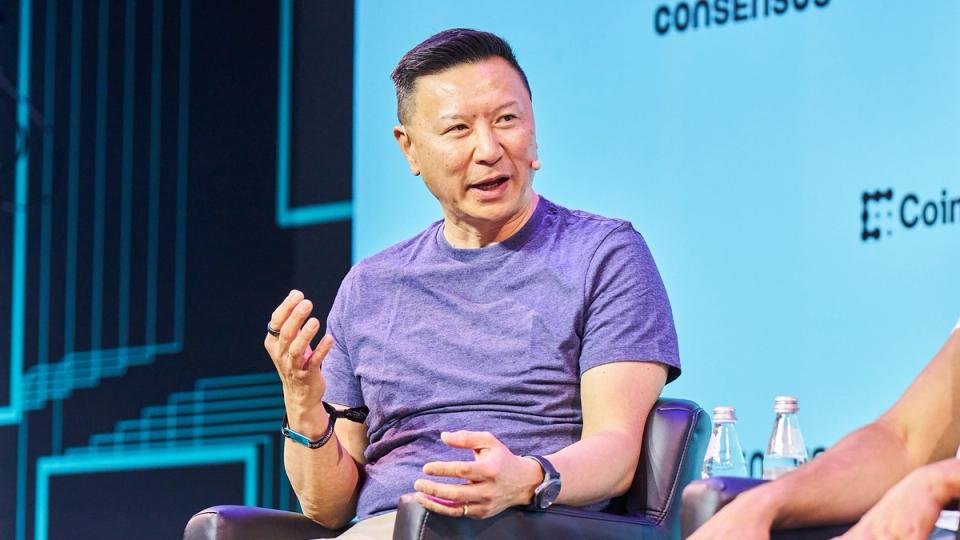
Anthony Soohoo, Chairman and CEO of MoneyGram, speaking at Consensus 2026 (CoinDesk)
Summary
Show
MoneyGram CEO Anthony Soohoo said the company's blockchain strategy is focused on modernizing cross-border payments, by using blockchain infrastructure to make remittances faster, cheaper and more transparent while keeping the technology invisible to customers.
While Stellar remains a core blockchain partner, MoneyGram is expanding its blockchain footprint through validator roles on Solana and Tempo and sees its MGUSD stablecoin as a way to build more financial products within its own ecosystem.
MoneyGram has spent years experimenting with blockchain technology, but CEO Anthony Soohoo says the company’s latest crypto-related revelation is that it works best when customers don’t have to think about it.
Speaking in an interview with CoinDesk, Soohoo said MoneyGram's blockchain strategy has evolved from early experimentation into a broader effort to modernize the company's global payments infrastructure. The remittance giant, which serves roughly 60 million active customers, sees blockchain less as a consumer-facing feature than as a way to make cross-border payments faster, cheaper and more transparent.
"What you're always looking for is how to leverage technology to run your business more efficiently and effectively," Soohoo said. "The use case is what do our customers want, and how do we solve that for them?"
MoneyGram's customers are primarily people sending money to friends and family abroad, making speed and cost two of the biggest priorities. Traditional cross-border payments can take days to settle and often rely on banking hours and multiple intermediaries, making the experience cumbersome and expensive. But the firm believes that blockchain can streamline that process by enabling around-the-clock settlement and lowering operating costs, saving the company hopes to eventually pass on to customers.
In attempting to modernize and better meet its customers’ needs,
MoneyGram has partnered with the Stellar network
, which has underpinned many of the company's blockchain initiatives over the past five years.
But the company has also started exploring other ecosystems
: while Stellar remains a core partner, MoneyGram
has also become a validator on Solana
and Tempo. For MoneyGram, the immediate payoff isn't speculative crypto activity, it's replacing legacy financial rails.
Today's cross-border settlement still largely depends on banking hours and weekday processing. Blockchain-based infrastructure, Soohoo argued, enables real-time settlement around the clock, reducing operational costs while improving the customer experience.
"We believe if we do it right, we can achieve all three," he said, referring to helping customers save time, effort and money. Instant settlement also allows MoneyGram to lower back-office costs, savings the company hopes to eventually pass on through lower prices. Currently, MoneyGram’s fees start at $1.89 and vary depending on what country you send them to.
Soohoo doesn't believe consumers need to understand the technology powering those improvements. He compared blockchain to the processors inside Apple's iPhone.
"I can't tell you what processor is inside my iPhone," he said. "I just know it's faster." In the same way, he argued, remittance customers care about whether money arrives quickly and reliably, not whether it traveled over a blockchain.
That philosophy also explains the company's recently introduced stablecoin strategy. Rather than building a token designed for institutional markets or crypto traders, MoneyGram's MGUSD is
intended primarily for use inside the company's own payments ecosystem
. Soohoo said owning the infrastructure gives MoneyGram greater control over costs and future product development, including wallet features, rewards programs and other financial services.
"If someone's sending money from MoneyGram to MoneyGram, why shouldn't it be our own coin?" he said, describing the stablecoin as part of a broader effort toward vertical integration.
Soohoo, who joined MoneyGram roughly 18 months ago after leading digital transformations at Walmart, said his own view of blockchain has expanded since arriving at the company.
"The opportunity with blockchain and digital currencies is actually bigger than I had anticipated," he said. Still, he cautioned that many financial institutions remain overly focused on announcing blockchain initiatives rather than solving customer problems. "The common misconception...is that they get lost in the product," Soohoo said. "These are infrastructure conversations. They're not consumer conversations."
Ultimately, MoneyGram's blockchain ambitions extend beyond remittances. Over the next three to five years, Soohoo said the company's goal is to become the primary financial institution for its customers, many of whom are underbanked, and use blockchain as one of the technologies that helps democratize access to financial services.
"Our goal would be to democratize finance for the MoneyGram customer," he said.
Read more:
MoneyGram launches stablecoin on Stellar, joining rush toward digital dollar payments
Newsletters
MoneyGram
Latest Crypto News
1
Augustus raises $180 million to build a clearing bank for the AI and stablecoin era
48分钟前
2
Jack Mallers steps down as XXI Capital CEO as Tether's plans to merge three bitcoin firms falls
2小时前
3
Bitcoin rally has broad-based support as institutions, whales, options traders pile in
3小时前
4
Clarity odds jump to 43% on Polymarket after unverified reports Trump agreed to ethics deal
3小时前
5
Crypto markets rally on Clarity progress report, Asian chip-stock rebound
4小时前
6
XRP jumps 4% as traders watch 'triangle breakout' toward $1.35
7小时前
7
Live markets: Bitcoin rises to five-week high near $67,000 on boosted hope for Clarity Act
8小时前
8
UK Parliament begins inquiry into banking chokepoint for crypto businesses
9小时前
9
Bitcoin hits one-month high above $66,000 as the chip trade turns back into a tailwind
9小时前
10
Inside Cardano's 'Van Rossum' hard fork, and what it means for users
2026年7月20日
Latest Research
TRON Network - Q2 2026
TRON Network - Q2 2026
In Q2; TRON's stablecoin dominance rose to 28.7%, USDT supply on TRON hit $89B ATH, $89M in protocol fees (2nd to Hyperliquid), TRX +3%, and deepening institutional & agentic reach.
By
CoinDesk Research
2 hours ago
Commissioned by
Tron
In Q2; TRON's stablecoin dominance rose to 28.7%, USDT supply on TRON hit $89B ATH, $89M in protocol fees (2nd to Hyperliquid), TRX +3%, and deepening institutional & agentic reach.
Why it matters
:
In Q2; TRON's stablecoin dominance rose to 28.7%, USDT supply on TRON hit $89B ATH, $89M in protocol fees (2nd to Hyperliquid), TRX +3%, and deepening institutional & agentic reach.
View Full Report
More From
Tech
Live updates: Bitcoin rises to one-month high of $65,700 before pulling back with stocks
Moonshot AI IPO push follows Kimi, Alibaba AI releases that shook bitcoin
Bitcoin's biggest advocate, Michael Saylor, says new plan to clean up the blockchain is 'a bad idea'
Crypto
CD20
$1,803.89
CD20 up 2.19 percent
2.19%
BTC
$66,647.30
BTC up 1.68 percent
1.68%
ETH
$1,927.23
ETH up 1.41 percent
1.41%
XRP
$1.15
XRP up 3.32 percent
3.32%
SOL
$77.86
SOL up 0.23 percent
0.23%
Original YayaNews editorial coverage, published for informational purposes.
This article is sourced from CoinDesk. It is for informational purposes only and does not constitute investment advice.
Topics & Symbols
Continue Reading
Related Reading
Upbit Lists PROM with KRW and USDT Trading Pairs, Opening New Opportunities for Mid-Cap Tokens
Upbit announced the addition of PROM KRW and USDT trading pairs, with a market cap of approximately $43.5 million. This article analyzes the significance, project background, and market impact for investors.

SEC Prepares Major Crypto Plan as Clarity Act Stalls: What It Means for Markets
As the Clarity Act remains gridlocked, the SEC is reportedly preparing a significant crypto regulatory plan. This article analyzes potential new rules covering DeFi, stablecoins, and exchanges, market reactions, and the global competitive pressures shaping U.S. oversight.

Binance Launches DOSUSDT Perpetual Contract: Market Impact and Investment Strategy Analysis
Binance announced the listing of the USDⓈ-M DOSUSDT perpetual contract on August 11, 2026. This article analyzes the announcement background, market reactions, and investment risks to help investors seize opportunities.
Ireland Plans Industry Standards for Illicit Crypto Use
The strategy prepared by the Irish government’s finance department included industry standards on crypto used for gambling and strengthening AML/CFT measures in certain cases.